Sterling Heights moves from AI analysis to action
Equipping 600 employees to serve 135,000 residents better.
In this story
-
 Dale DwojakowskiAssistant City Manager
- City of Sterling HeightsMichigan
When the City of Sterling Heights began exploring artificial intelligence, the opportunity was clear—but so was the risk of getting stuck evaluating an endless stream of new tools.
Chapter 1: The decision
“We had an AI task force with people from across the organization looking at many different options. At some point, it became analysis by paralysis. There will always be another shiny new technology just around the corner. But while you wait, your staff is missing the opportunity to use a tool that can help them work more efficiently and serve residents better.”
Dale DwojakowskiAssistant City Manager, City of Sterling Heights Rather than wait for the market to settle, Sterling Heights made a decision: move forward, learn through responsible use, and give employees a practical productivity tool now. The City selected GovAI and rolled it out to all 600 full-time employees.
Chapter 2: Getting started
From exploration to organization-wide adoption
For Sterling Heights, success required more than purchasing technology. It required visible leadership, a cross-department implementation strategy, and an emphasis on employee ownership.
Dwojakowski helped move the City from broad exploration to action, recognizing that successful AI adoption needs someone willing to make a decision and champion the work across the organization.
“Technology is always going to change. The important thing is to get started with a solution that is useful, safe, and built for government—then help your employees learn how to use it well.”
Dale DwojakowskiAssistant City Manager, City of Sterling Heights GovAI gave Sterling Heights a government-focused platform that employees could use for daily work while keeping the organization’s needs, workflows, and public-service mission at the center of the rollout.
What it added up to
3.5 hrs Before → 15 min With GovAI
Staff used GovAI to analyze and summarize the material. They still review the result and own the final work.
Source: City of Sterling Heights, one report-review process.
Chapter 3: How they use it
Saving time across City departments
Sterling Heights has seen GovAI create value across departments, including the Library, Parks and Recreation, Police, Fire, Department of Public Works, City Hall, Administration, and Budget.
The platform supports a wide range of staff work—from reviewing and summarizing reports to drafting communications, preparing funding materials, organizing data, and developing first drafts of documents that employees can then review and refine.
In one example, a report-review process that previously required about three and a half hours of staff time was reduced to approximately 15 minutes using GovAI to analyze and synthesize the material. Staff still review the output and remain responsible for the final work product, but the tool eliminates much of the repetitive first-pass effort.
Other City use cases include:
Chapter 4: Who owns the work
“The goal is not to replace the employee. The employee still needs to proofread, validate, and own the final document. But GovAI can help remove the time-consuming parts of the work so people can focus on judgment, service, and outcomes.”
Dale DwojakowskiAssistant City Manager, City of Sterling Heights Chapter 5: For residents
Making AI accessible to employees—and residents
Sterling Heights also chose GovAI for its public-facing chatbot, replacing a traditional website-search experience with a conversational way for residents to find information.
For a city serving a diverse community, accessibility was an important consideration. GovAI supports resident questions in English and Arabic, helping residents interact with City information in the language that is most useful to them.
The City’s early usage data demonstrated meaningful engagement. Across the employee and public-facing experience, GovAI recorded approximately 1,000 active users in a 30-day period, while the public assistant was receiving roughly 100 prompts per day.
The City views this as an important foundation—not an endpoint.
“We are continuing to encourage use, identify where additional training would help, and understand which teams have the greatest opportunities for AI-assisted work. A desk-based employee may have different use cases than someone performing field work or highly repetitive operational tasks. Adoption is not one-size-fits-all.”
Dale DwojakowskiAssistant City Manager, City of Sterling Heights 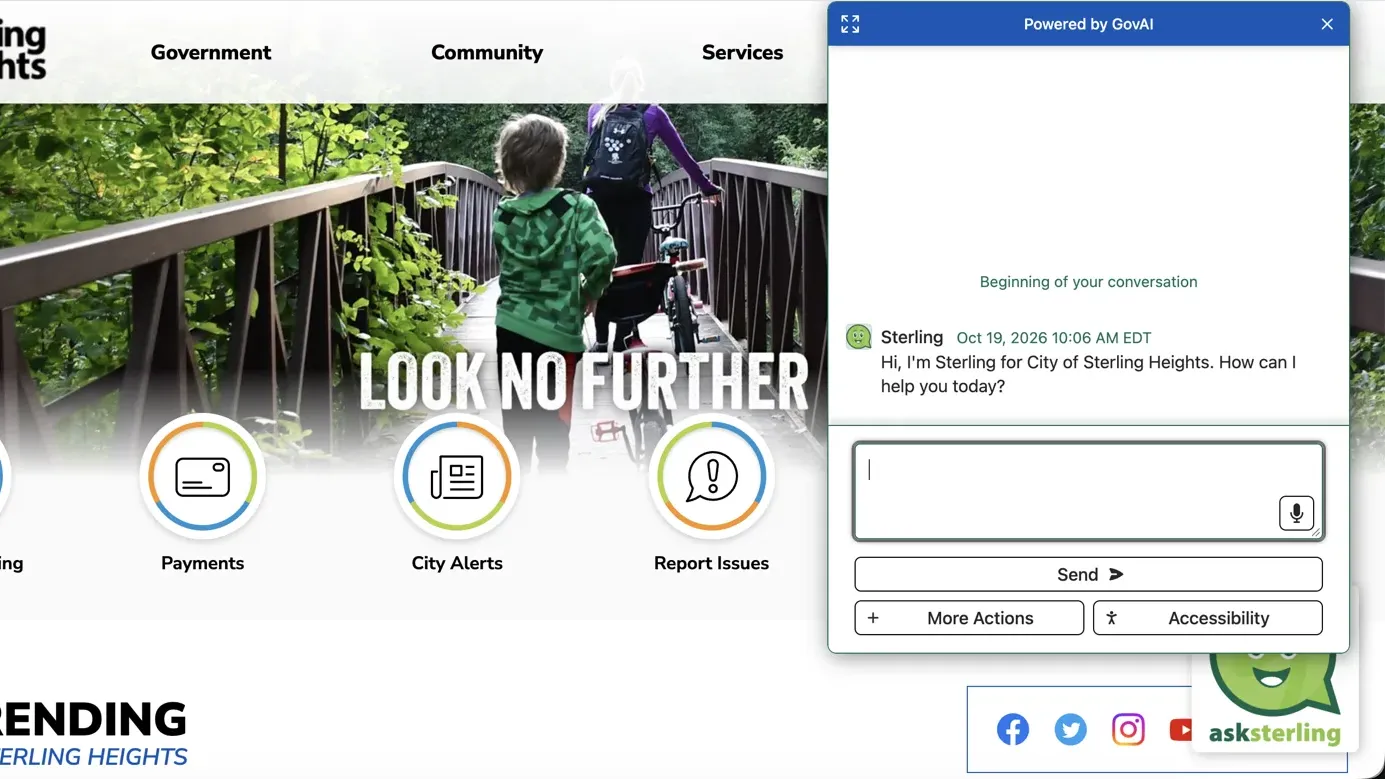
Chapter 6: One approved tool
A government-focused alternative
As employees encounter AI tools in their personal lives and across the broader technology market, Sterling Heights wanted to provide a practical, organization-supported option for city work.
The City communicated a clear message to employees: use the approved GovAI platform for work-related tasks rather than relying on free, consumer-oriented AI services for City information.
That approach gives staff access to a tool designed around public-sector needs while helping the organization establish consistent expectations for responsible use.
Chapter 7: The lesson
Building a culture of responsible innovation
Sterling Heights’ experience offers a practical lesson for local governments considering AI: waiting for a “perfect” solution can delay real benefits for employees and residents.
The City did not approach GovAI as a one-time technology purchase. It approached the implementation as an ongoing program of adoption, training, experimentation, and continuous improvement.
For Dwojakowski, the decision was ultimately about municipal service.
“Our responsibility is to find better ways to serve 135,000 residents. If a tool can save staff time, improve the quality of our work, and help us respond more effectively to the public, we should be willing to explore it responsibly. GovAI has given us a practical way to do that.”
Dale DwojakowskiAssistant City Manager, City of Sterling Heights More customer stories
Tell us what's piling up.
We'll help you pick the first task to hand off to AI.